Late July at home usually looks like this: your kid falls asleep at 1am, gets up at noon, and there is always something cold and something snacky within arm's reach. Meanwhile, the first alarm of September is already counting down.
The most common reaction at this point is to start buying things. But what actually determines how your child shows up in September is usually not the bottles in the cabinet. It is a sleep schedule that has drifted, a digestive system worn down by two months of cold drinks and snacks, and a body still running in summer mode.
A couple of dates worth noting: in 2026, Start of Autumn (立秋) falls on August 7, and End of Heat (處暑) falls on August 23, which is also the last day of the final fu period this year. Summer's exit and the school bell land in almost the same week.
The good news: one month is enough. Here are three signals. Whichever one you notice first is the one to work on first.

1. Hard to wake up, but drowsy all day
The American Academy of Sleep Medicine recommends 9 to 12 hours of sleep for kids aged 6 to 12, and 8 to 10 hours for teens aged 13 to 18. In CDC survey data, more than seven in ten high schoolers fall short on school nights.
And "a little less sleep is no big deal" does not hold up. In one study , teachers who had no idea which condition each child was in rated the kids' behavior. Roughly half an hour of extra sleep was enough to move the scores on emotional steadiness and the ability to sit still. The Suwen puts it another way: when a person lies down, the blood returns to the liver. Same idea. Only when someone is genuinely asleep does the body get restored enough for the eyes to focus and the limbs to work.
What you can do this month:
-
Start two to three weeks early, and shift by 15 minutes every few days. Falling asleep at 1am and needing to be up at 7am is a three-hour gap, and closing it gently takes about that long. Kids barely register 15 minutes, so they rarely push back.
-
Fix the wake-up time, not the bedtime. Lying in bed "trying to fall asleep earlier" almost never works. Getting up earlier is the lever that actually moves things.
-
Get them outside in the morning. Morning light genuinely resets the body clock , but pulling the curtains open for a few seconds does not count. They need to actually be outdoors for a while.
-
Dim the lights before bed. Children have larger pupils and clearer lenses, which makes them more light-sensitive than adults. Kill the overhead lights and put the screens away an hour before bed.
After Start of Autumn it gets dark earlier, which is exactly when the body is most willing to accept an earlier bedtime. Adjusting in August works with the season. Adjusting in September works against it.
💡 From the editor: You do not need a family meeting to announce that everyone is going to bed early now. Quietly move dinner up, dim the lights, and put one unmissable outdoor thing on the weekend morning calendar. Most kids never notice they are being adjusted, which is why they do not resist.

2. Poor appetite, bad breath, restless nights
Chinese medicine has a classic description of children: their organs are delicate and their form and energy are not yet complete. The most widely quoted line from it is that the spleen is often insufficient. A child's digestion is more fragile than an adult's to begin with, and two straight months of eating too much, too randomly, and too cold tends to back things up.
One of the ways that backup shows up is heaviness and fatigue. Which is why so many kids sleep a full ten hours and still drag through the day.
How do you tell if it is food stagnation ?
-
Breath: a sour, fermented smell
-
Tongue: normally pale red with a thin white coating; with stagnation the tongue looks redder and the coating thickens
-
Stool: more sour-smelling than usual, or dry and infrequent
-
Sleep: tossing, kicking off the blanket, grinding teeth, talking in their sleep
-
Palms and soles: warm to the touch
If two or three of these show up together, food stagnation is the likely answer. But if a week of adjustment does not help, or things get more obvious instead, do not tough it out. See a doctor.
The two easiest signs to misread are the last ones. "When the stomach is unsettled, sleep is unsettled" is an old line that says exactly this: when a child rolls around all night, the answer is usually far more mundane than "stress." Dinner was too big, too late, or too greasy. Then they sleep badly, drag through the next day, the parents decide the kid needs building up, the food gets richer, and the sleep gets worse. That loop is the most common thing we see at back-to-school season.
Chinese medicine also connects the spleen to thinking, and holds that overthinking taxes it. Going back to school means a child is suddenly using their brain, taking tests, and adapting to a new environment. In that framework, the fact that so many kids inexplicably lose their appetite in the first two weeks is not a coincidence.
Lightening the load in August beats adding anything:
- Eat to about 70 or 80 percent full. "For a child to stay well, keep them slightly hungry and slightly cool." Just do not take it to an extreme.
- Move cold drinks from "whenever" to "occasionally." Serve drinks at room temperature and let fruit sit out for half an hour.
- Move dinner an hour earlier and cut the grease in half. This is the highest-return change on the list.
- Choose gentle ingredients: Chinese yam, lotus seed, poria, euryale seed, millet, pumpkin. Yam is the safest bet. It is mild and nourishing without being heavy, and it works fine in a simple congee.

3. Tired from any activity, sweaty, itchy nose
"My kid gets sick every year right after school starts" is not your imagination. The first weeks back are already a small peak for respiratory viruses, and ragweed season starts in August and peaks in mid-September. So that "cold" your child has in September is sometimes actually an allergy. (One more thing worth knowing: most kids get at least six to eight colds a year. A run of runny noses usually is not a weak constitution. It is a sudden increase in exposure.)
Their bodies are changing season too, and more slowly than ours . Summer moves outward: pores open, we sweat, and yang energy sits near the surface. Autumn pulls inward. Because children's organs are delicate, they switch over more slowly and get stuck partway more easily. Stuck looks like this: sweating at the slightest activity, crashing in the afternoon, sneezing at the first breeze.
Autumn brings its own challenge. Chinese medicine describes the lung as a delicate organ that likes moisture and dislikes dryness , and children are said to have insufficient lung energy specifically. Chapped lips, a dry nose, an uncomfortable throat first thing in the morning, a dry cough in late August and early September: most of that is not a cold, it is dryness.
Which direction to go:
-
Less pungent, more sour: cut back on scallion, ginger, garlic, and chili; add hawthorn, grapes, and lemon.
-
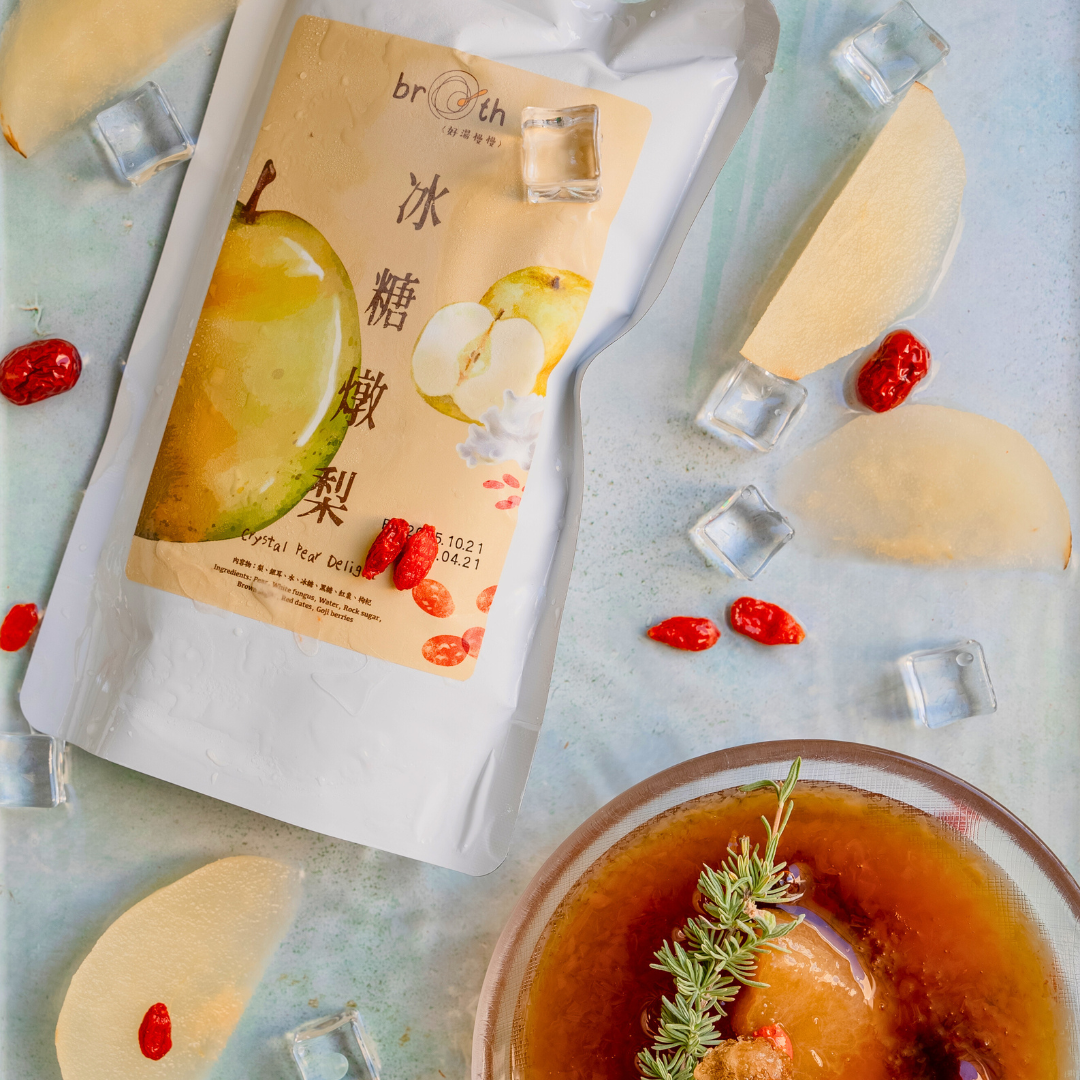
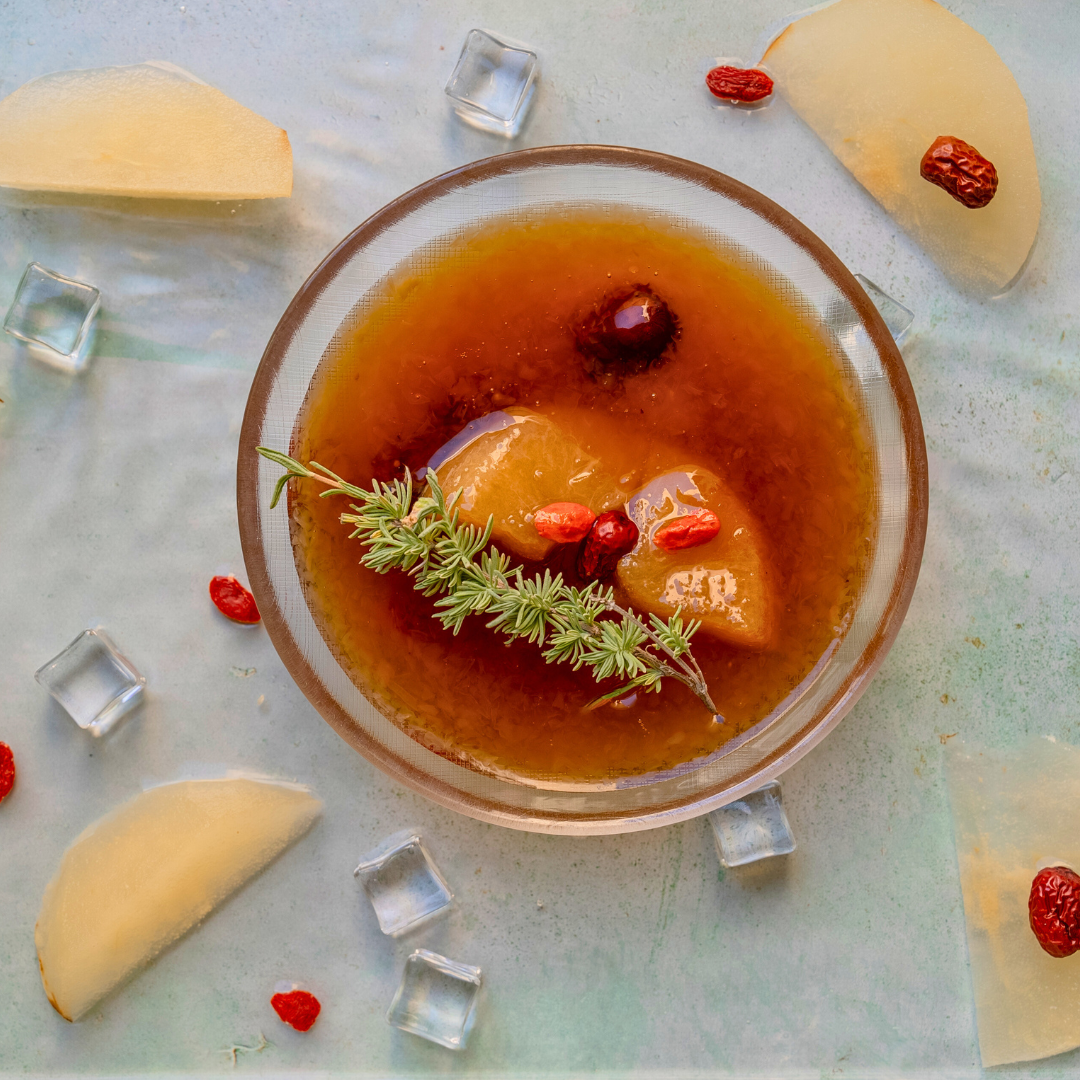
White foods to moisten: lily bulb, snow pear, water chestnut, Chinese yam, white fungus, lotus seed. Lily and lotus seed congee, white fungus and snow pear dessert soup, yam and pork rib soup all work. They are food first and wellness second, which means your kid will actually eat them and you will not have to negotiate.
-
After sweating, do more than rehydrate: sweat is described as the fluid of the heart, and sweating a lot depletes energy. After exercise, a bowl of warm soup serves them better than a glass of ice water.

Two more things worth mentioning
One: do not put adult herbs in a child's soup. Sun Yat-sen Memorial Hospital has published a list of herbs to avoid in children's soups : adenophora, polygonatum, and ophiopogon can deplete yang energy with long-term heavy use; donkey-hide gelatin, prepared rehmannia, and angelica are too cloying for children; placenta, deer antler velvet, and royal jelly may contribute to precocious puberty; and astragalus should not be used while a cold is still unresolved.
Two: do not rush to build them back up right after an illness. Chinese medicine has a term for this, shifu, which describes an illness returning because of inappropriate nourishing food afterward. It is the same idea as "too depleted to absorb the tonic." The right order is warm, soft, plain, easy-to-digest food first, then gentle nourishment once the appetite has genuinely come back.
💡 From the editor: What that same source actually recommends for children is pretty humble: Chinese yam, euryale seed, lotus seed, poria, hawthorn, and pseudostellaria. Pseudostellaria is described as the mildest of the qi-supporting herbs, weaker than ginseng or codonopsis. That weakness is precisely what makes it suitable for kids. When it comes to making soup for children, simpler is usually more correct.

If you only do three things this August
-
Fix the wake-up time. Start two to three weeks early, shift 15 minutes every few days, and get them outside into the light in the morning.
-
Lighten the digestive load. Dinner earlier and plainer, 70 to 80 percent full, and check the tongue, the breath, and how they sleep.
-
Change the menu with the season. Less pungent, more sour; white foods to moisten; something warm after they sweat.
As for building them up, please put that after those three. When the schedule is a mess and digestion is backed up, the body cannot absorb what you add anyway. Children's bodies are sensitive and quick to respond. They go off the rails fast, and they come back fast too.

About the soup part
If you want something gentle on hand at home, plain is usually the easiest choice, because it does not stack any herb's particular tendencies on top. Chicken itself is considered mild in Chinese medicine, neither cooling nor drying, which is a good part of why it has worked as a household soup base for centuries.
Original Organic Chicken Essence is made simply: USDA organic whole chicken, steam-extracted drop by drop for over 8 hours, with no water, no salt, and no seasoning added. One pouch is 65ml, with zero fat and zero cholesterol. Warmed and taken on an empty stomach in the morning, it is at least something in the tank for the kid who never has time for breakfast.
For the pot that goes on the family table, Morel & Cordyceps Vitality Chicken Soup is 900g. Add noodles and some greens and it is dinner. The cordyceps flower, morel, red date, and goji in it are not on the avoid list above, but this pot was built for a whole family's table, so for younger children we would suggest more broth and fewer solids. Allergens include crustacean shellfish, milk, and mushrooms. If your child has a particular constitution, is currently ill, or is taking medication, please check with your pediatrician or Chinese medicine practitioner first.
We are not going to tell you that drinking this will help your child test well or sit still. No food does that. But a steady schedule, a digestive system that is not being fought, and a bowl of warm soup: those things added together are what we can actually give them heading into September.
August is still long. Take it slowly. See you in September :)
For more wellness reading, come browse the WeLoveBlog.

REFERENCES
- American Academy of Sleep Medicine. Recommended Amount of Sleep for Pediatric Populations: A Consensus Statement. J Clin Sleep Med, 2016. View source
- CDC. Short Sleep Duration Among Middle School and High School Students, United States, 2015. MMWR 2018;67(3):85-90. View source
- Gruber R, et al. Impact of Sleep Extension and Restriction on Children's Emotional Lability and Impulsivity. Pediatrics, 2012. View source
- Sleep Foundation. Back to School Sleep Tips. View source
- AAP / HealthyChildren.org. Where We Stand: Vitamin Supplements for Children. View source
- AAFA. Ragweed Pollen Allergy. View source
- Beijing Jishuitan Hospital, Prevention and Care for Food Stagnation in Children (in Chinese). View source
- Guang'anmen Hospital, China Academy of Chinese Medical Sciences, Start of Autumn: Yang Recedes as Yin Grows, Nourish the Lung with Moisture (in Chinese). View source
- Sun Yat-sen Memorial Hospital, Herbal Soups Are Not for Children to Drink Freely (in Chinese). View source
- Beijing Children's Hospital Shunyi Women's and Children's Hospital, Don't Rush to Nourish a Child After Illness (in Chinese). View source
-
Huangdi Neijing, original text
- BROTH. Chicken Essence FAQ. View collection